Peking Duck: Why the ‘Best Part’ Isn’t the Meat
The dish is named for a bird, but the prize is the skin — lacquered, shatteringly crisp, and centuries in the making. Here is how it happens and how to order it.

Ask anyone what Peking duck is and they will say “roast duck.” They are not wrong — but they are pointing at the wrong part of the bird. The whole ceremony, the centuries of imperial refinement, the theatrical carving at the table: all of it exists to deliver the skin. Glassy, mahogany-lacquered, and so crisp it audibly cracks, the skin is the dish. The meat is the encore.
A dish born in the palace
Roast duck has been eaten in China for many hundreds of years, but the refined version we now call Peking (Beijing) duck matured in the imperial capital, entering court kitchens by the Ming dynasty and becoming a celebrated Beijing specialty under the Qing. Two houses came to define its styles: the older closed-oven method associated with Bianyifang, where ducks roast in the residual heat of a sealed brick oven, and the open, hung-oven method made famous by Quanjude in the 1860s, where birds hang over a fire of fruitwood — date, peach, or pear — that perfumes the skin as it renders.
From the palace it became a symbol of Beijing itself, the dish visiting dignitaries were taken to eat, and the standard by which a northern kitchen is still judged.
The craft: how the skin becomes glass
That crackle is not luck. It is the product of a long, patient process designed to do one thing — drive every trace of moisture and fat out from under the skin so it can crisp instead of steam.
Air, not just heat
- Air-separating the skin. A white Beijing duck is cleaned and air is pumped between the skin and the flesh so the two lift apart. This is why the skin can crisp on its own rather than clinging to the fat below.
- Scalding and glazing. The bird is doused in boiling water to tighten the skin, then brushed with a maltose-sugar syrup that caramelizes into that deep lacquered color.
- The long dry. The glazed duck is hung in a cool, airy room for many hours — often overnight — until the skin turns taut and papery. This drying step is the real secret; a rushed duck will never crackle.
- The roast. Only then does it meet the fire, turning slowly until the skin is the color of dark amber and the fat beneath has rendered almost completely away.
Done right, the skin shatters like thin caramel and the fat is gone — that is the whole point. A Peking duck judged by its meat has missed its own purpose.
The traditional first bite is skin alone, dipped in a little white sugar. No pancake, no sauce — just crackling skin and a few grains of sugar, so nothing competes with the texture the kitchen worked all day to build.
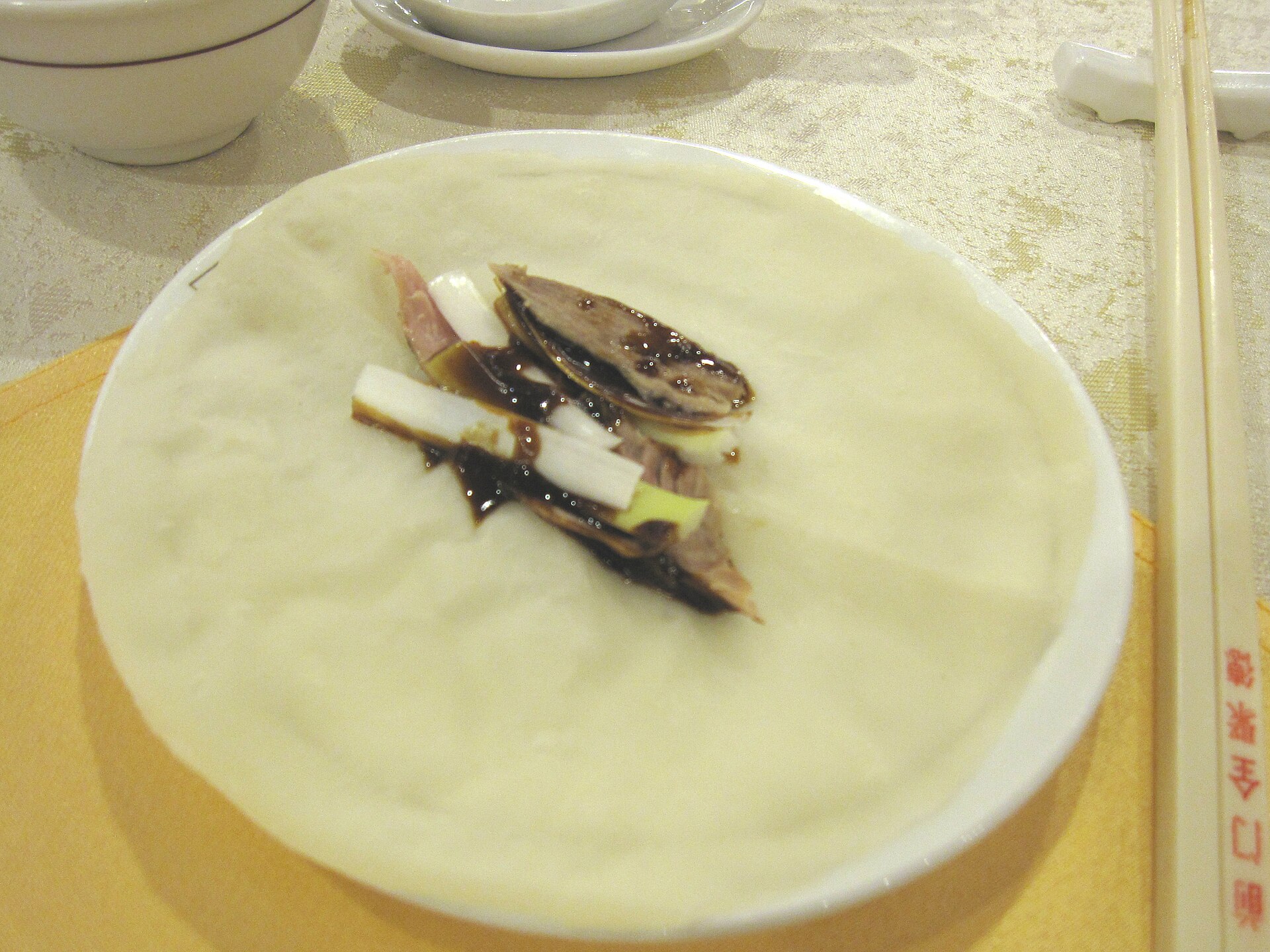
The ritual: building the perfect roll
After that first taste, the meal becomes hands-on. The classic wrap is assembled by you, at the table, and there is a right order to it:
- Take a thin, steamed lotus-leaf pancake (or a fluffy steamed bun at some houses).
- Use your chopsticks to swipe a little sweet bean or hoisin sauce across it — a smear, not a flood.
- Lay in a piece or two of skin-and-meat, ideally with a shard of pure crisp skin on top.
- Add slivers of scallion and cucumber — their sharp, cool crunch is there to cut the richness.
- Fold the bottom up, roll the sides in, and eat it in a couple of bites while the skin is still crisp.
The balance is the genius of it: fatty-sweet skin, savory sauce, raw allium bite, cool cucumber, all wrapped in something soft and neutral. No single element dominates — which is exactly why the pure-skin first bite comes before you bury it in a pancake.
One duck, three ways
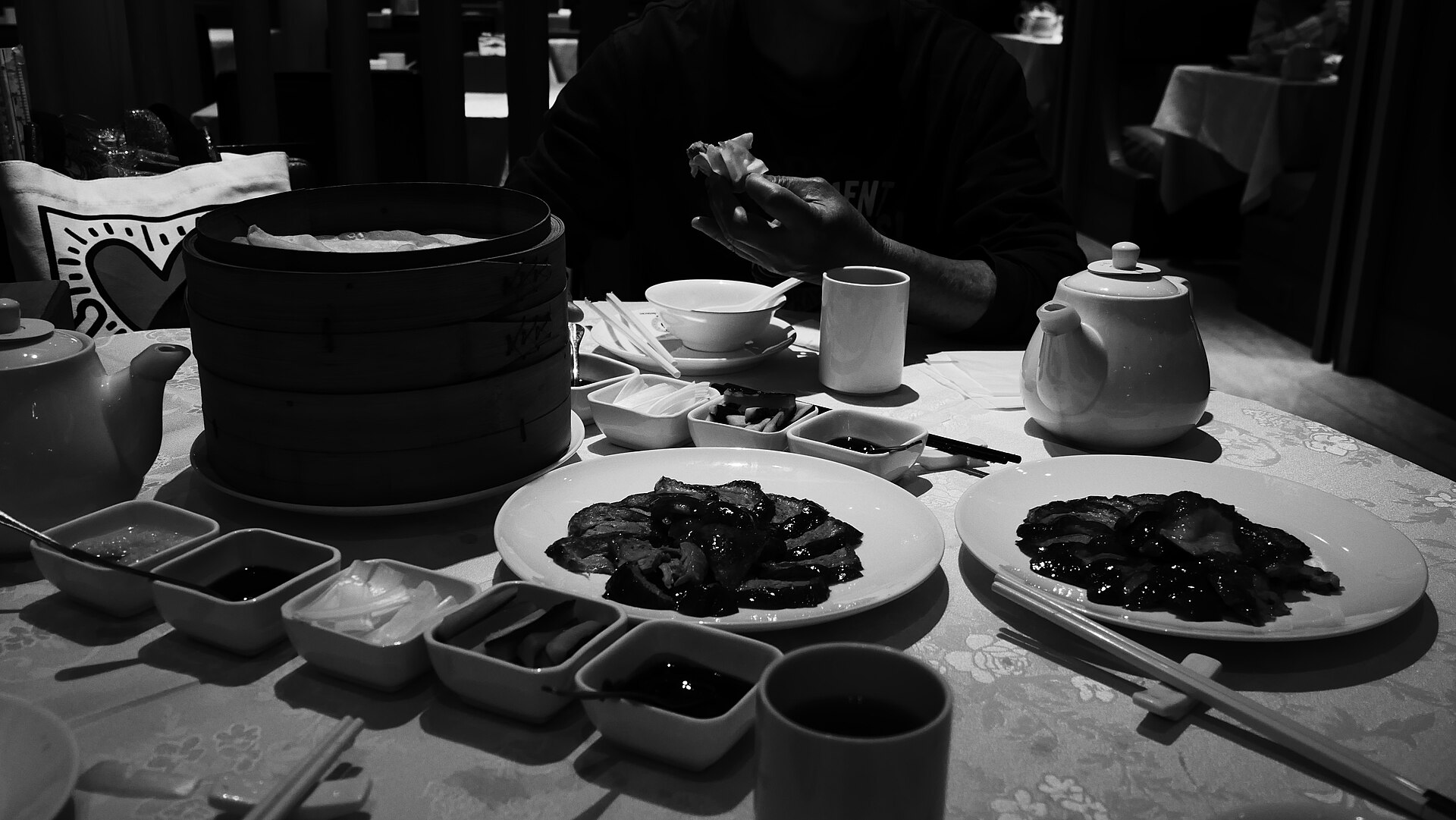
A proper Peking duck is a multi-course event built from a single bird — the kitchen wastes nothing.
- Course one — the skin and pancakes. The chef carves the bird tableside into dozens of pieces, prioritizing the prized crisp skin, and it arrives while still hot.
- Course two — the meat. The remaining duck meat is often stir-fried — classically with bean sprouts, or minced and served in lettuce cups — a savory second act.
- Course three — the soup. The carcass and bones are simmered into a milky, comforting duck soup, sometimes with napa cabbage or winter melon, to close the meal.
How to order it
- Call ahead when you can. A true air-dried duck can take a day to prepare; many restaurants ask you to pre-order whole ducks, and it is worth it.
- Order the whole duck for the table. It is a sharing dish, usually priced per bird and often carved in front of you — half-duck options exist for smaller groups.
- Ask how they want the meat. Many places let you choose the second-course preparation (stir-fried, lettuce wraps) and whether you want the soup.
- Eat the skin first, and fast. Crispness is fleeting — the roll you build in the first five minutes is the best one you’ll eat.
Peking duck sits at the pinnacle of northern Chinese cooking, a world away from the Cantonese south. If you want to see where it fits, our guide to the regional cuisines of China maps the whole landscape.
Find Peking duck near you — and order direct
Many of the northern and Beijing-style restaurants in our directory serve Peking duck and let you order online directly, with no third-party delivery fees. Browse the JinsCafe restaurant directory to find one near you, and read real diner reviews and ratings before you book that duck. For another Chinese dish with a story worth knowing, see the truth about General Tso’s chicken.